For much of the period after the Second World War, the American economic story was relatively straightforward.
Businesses became more productive. The economy became larger. Workers produced more value. And, broadly speaking, workers shared in the benefits.
Then something changed.
America continued becoming richer. Companies continued becoming more productive. Technology improved. International trade expanded. Corporate values grew.
But the connection between increasing productivity and the prosperity of the typical American worker began to break.
The result is one of the most important economic changes of the past half-century:
America did not stop creating wealth. It changed who participated in creating and accumulating that wealth.
And because this transformation occurred gradually, while consumers simultaneously gained access to increasingly inexpensive imported products, much of it happened in plain sight.
When Productivity and Pay Travelled Together
The starting point is productivity.
Productivity essentially measures how much economic output can be produced from an hour of work. Rising productivity is enormously important because it allows a society to become wealthier without simply requiring everyone to work longer.
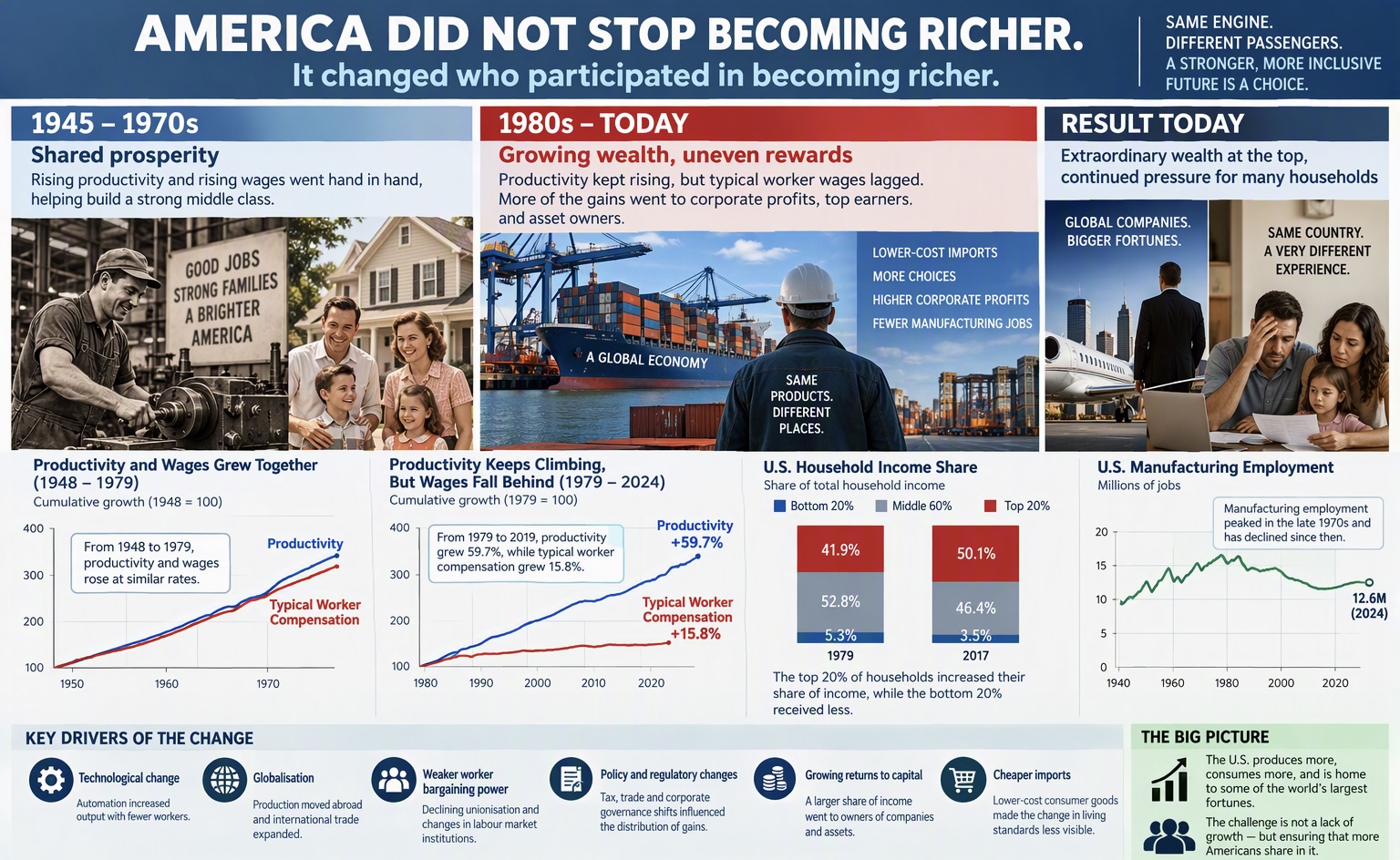
For decades following the Second World War, increased productivity and workers’ compensation moved broadly together.
Research from the Economic Policy Institute describes inflation-adjusted pay and productivity as growing largely in “lock step” from the end of the Second World War until the 1970s. After 1979, the two began to diverge. That distinction matters.
Workers weren’t simply receiving salary increases because companies were feeling generous.
Workers were becoming more productive, businesses were creating more economic value, and some of that increasing value found its way back into workers’ compensation.
Economic growth therefore translated relatively directly into rising living standards.
Then the relationship changed.
1979 Is an Extraordinary Dividing Line
No single year caused the transformation, and different economic measures identify slightly different turning points.
Nevertheless, 1979 provides a remarkably useful dividing line.
According to analysis from the Economic Policy Institute, between 1979 and 2019, net productivity increased by 59.7%, while compensation for the typical worker increased by only 15.8%. That is an extraordinary divergence.
Employees continued creating more value per hour.
But their compensation no longer increased proportionately with that productivity.
This doesn’t mean workers received none of the benefits of economic development. Nor does it mean every worker experienced the same outcome.
It means something more structural had happened:
Increasing the size of the economic pie no longer necessarily meant proportionately increasing the slice received by the typical worker.
And the distributional data reinforce the point.
A Congressional Research Service analysis found that between 1979 and 2018, inflation-adjusted hourly wages increased by just 1.6% for workers at the 10th percentile, 6.1% at the 50th percentile, but 37.6% at the 90th percentile. Growth continued.
Participation in that growth became increasingly unequal.
The Economy Wasn’t Shrinking
This is where the distinction becomes important.
It would be easy to interpret stagnant wages, industrial decline in some regions and increasing household financial pressure as evidence that America itself had stopped becoming wealthier.
But that isn’t what happened.
Productivity continued rising.
The distribution of the resulting income changed.
There was increasing inequality between workers, but also a changing relationship between labour and capital.
The same Congressional Research Service analysis found that the share of income going to the bottom fifth of households fell from 5.3% in 1979 to 3.5% in 2017, while the share going to the top fifth increased from 41.9% to 50.1%. It also identifies technological change, globalisation and changes in wage-setting institutions among the factors potentially contributing to growing wage inequality. That changes the question we should be asking.
Instead of:
“Did America continue becoming richer?”
we should ask:
“Where did the additional wealth go?”
The Changing Role of Work
For most households, labour is their primary economic asset.
They don’t own a factory.
They don’t own thousands of rental properties.
They don’t own significant percentages of multinational corporations.
They exchange their skill, knowledge and time for income.
That makes the relationship between productivity and compensation extraordinarily important.
If productivity increases and compensation rises with it, workers participate directly in economic growth.
If productivity increases substantially faster than compensation, the value created hasn’t disappeared. Someone still receives it.
The question becomes how that value is distributed between different workers and between labour and owners of capital.
Federal Reserve Economic Data, using figures from the US Bureau of Labor Statistics, explicitly defines labour’s share as the ratio of labour compensation to current-dollar output. This gives us a fundamentally different way of thinking about economic prosperity.
An economy can become considerably more productive without its typical worker receiving an equivalent improvement in compensation.
Then Globalisation Changes the Consumer Experience
There is another part of this transformation that deserves much more attention: imports.
American production and American consumption increasingly became separable.
Companies could manufacture products elsewhere while continuing to sell those products to American consumers.
The US Census Bureau maintains extensive datasets covering US imports by commodity, industry, state and other classifications. From the perspective of the consumer, globalisation could deliver an obvious benefit: access to goods manufactured using international supply chains.
But that also produces an intriguing economic effect.
The American worker and the American consumer are the same person.
As a worker, that person wants higher compensation and employment security.
As a consumer, that same person benefits from inexpensive products.
Those interests do not necessarily move together.
And here we arrive at what may be one of the least understood features of the transformation.
Cheap Products Can Create the Appearance of Prosperity
Imagine someone standing in their home surrounded by things previous generations could barely have imagined.
Large television.
Smartphone.
Laptop.
Microwave.
Internet connection.
Cheap clothing.
Consumer electronics.
Goods arriving at their door within days.
Measured in the quantity and technological sophistication of things they own, this person can appear extraordinarily wealthy compared with someone living in 1960.
Yet the same person might struggle to purchase a home or accumulate meaningful financial assets.
These conditions are not necessarily contradictory.
Modern global production can make manufactured products widely accessible while the rewards from domestic economic growth become distributed increasingly unevenly.
That leads to a provocative possibility:
Cheap consumer goods may have made the changing distribution of American economic prosperity considerably less visible.
This is an interpretation of the underlying economic developments rather than something the statistical data alone prove, but it provides an important way of looking at what happened.
People continued experiencing technological progress through what they bought.
What became less obvious was the changing relationship between what they produced and what they were paid.
The Disappearance of Manufacturing Jobs Made the Change More Visible
American manufacturing employment provides another perspective.
The Federal Reserve Bank of St. Louis series, based on US Bureau of Labor Statistics data, tracks American manufacturing employment all the way back to 1939. By September 2026, manufacturing employment stood at approximately 12.65 million people. The long-term series shows the substantial historical rise and subsequent decline in manufacturing employment over that period. But even here we need to be careful about the explanation.
It would be simplistic to say that globalisation alone caused declining industrial employment.
The Congressional Research Service review finds technological change to have been a major force behind increasing wage inequality, while most research it reviewed attributed a smaller overall effect to globalisation, although trade could have much larger effects on particular industries and locations. Automation, productivity improvements, technological change, trade and corporate organisation all matter.
The story is therefore considerably more subtle than “factories went abroad”.
The geographical organisation of production changed at the same time as technology transformed how much could be produced by each worker.
Meanwhile, Rewards at the Top Changed Dramatically
Another highly visible manifestation of the new distribution is executive compensation.
A 2007 Congressional Research Service examination of executive compensation reported that CEO pay had more than doubled over the preceding ten years and that the ratio of median CEO pay to worker pay had reached 179 to 1. The report specifically identified rising executive compensation as contributing to widening income inequality, while also examining competing explanations for why executive compensation had increased. This is important because the economic transformation isn’t simply about wages.
It concerns ownership, compensation, bargaining power and the allocation of the gains created by increasingly productive businesses.
Once wealth is accumulated as capital, another mechanism appears.
Capital compounds.
Shares can appreciate.
Businesses can grow.
Dividends can be reinvested.
Assets can generate additional assets.
Someone dependent primarily upon wages participates in the economy differently from someone whose income and wealth increasingly derive from ownership.
That distinction becomes more important as accumulated capital becomes concentrated.
Two Americas Can Therefore Exist Simultaneously
This explains something that otherwise seems contradictory.
America can simultaneously have:
extraordinarily valuable corporations, increasing productivity and enormous private fortunes
and
millions of households who believe economic life has become progressively less secure.
Both experiences can be real.
They simply describe prosperity from different positions within the economic system.
GDP measures economic production.
Productivity measures the efficiency with which economic activity occurs.
Corporate valuations measure expectations about businesses and their future earnings.
None of them directly answers the question an individual household asks:
“What does an hour of my labour allow me to obtain from this economy?”
That is a very different measurement of prosperity.
The Great Economic Change Was Distribution
This is why describing the last half-century simply as American economic decline misses the more interesting story.
America didn’t stop producing wealth.
It continued innovating.
Its businesses became extraordinarily valuable.
Productivity increased.
Its consumers gained access to products and technologies that previous generations could never have imagined.
But something fundamental changed in the relationship between production, labour, compensation and ownership.
The data do not support reducing this to a single cause. Technological change, globalisation, institutional changes and changing distributions of income all played roles of differing importance. But the outcome is difficult to ignore.
For decades after the Second World War, increasing economic productivity and the compensation of ordinary workers broadly travelled together.
Since the late 1970s, they haven’t. That leaves us with a profoundly different interpretation of modern American economic history.
The question isn’t:
“Why did America stop becoming richer?”
It didn’t.
The much more important question is:
Who participated in America becoming richer?
And perhaps that is the economic transformation we should have been discussing for the past forty years.
Data sources
- Economic Policy Institute, Productivity–Pay Gap, updated September 2026. Historical productivity and typical-worker compensation series, 1948–2026.
- Economic Policy Institute, Growing inequalities and the productivity-pay gap. Includes the 1979–2019 comparison of 59.7% net-productivity growth against 15.8% growth in typical-worker compensation.
- Congressional Research Service, Wage Inequality and the Stagnation of Earnings of Low-Wage Workers. Wage-distribution, income-share and analysis of potential causes of inequality.
- Federal Reserve Economic Data, All Employees, Manufacturing, sourced from the US Bureau of Labor Statistics. Long-run manufacturing employment series beginning in 1939.
- Federal Reserve Economic Data, Manufacturing Sector: Labor Share for All Workers, sourced from the US Bureau of Labor Statistics.
- US Census Bureau, USA Trade Online. Official US international merchandise-trade data resources.
- Congressional Research Service, The Economics of Corporate Executive Pay.