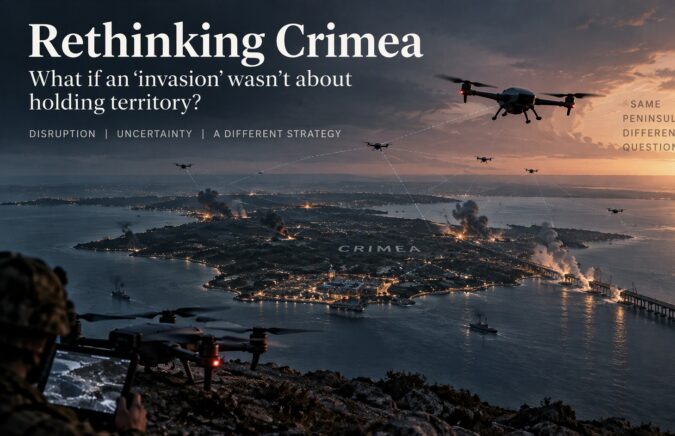
There is considerable speculation about what Ukraine might eventually do in Crimea.
Most of that speculation starts from a conventional military assumption: if Ukrainian forces enter Crimea, they must intend to capture territory, establish and defend a bridgehead, bring in additional forces, and progressively liberate the peninsula.
But that may be the wrong model.
I have been war-gaming a different proposition for some time.
What if the purpose of an initial Ukrainian entry into Crimea wasn’t to hold territory at all?
What if its purpose was disruption?
Crimea is already being disrupted
This distinction has become increasingly important because Ukraine does not need to begin by creating disruption. Much of that process is already under way.
The November operation against the Kerch Bridge followed a weeks-long Ukrainian campaign in which air-defence systems, radars and electronic-warfare capabilities were progressively attacked before Ukraine struck the bridge itself with drones and missiles. President Volodymyr Zelenskyy described the bridge strike as the seventh stage of the operation. The consequences are strategically significant. The Kerch Bridge is an important connection between Russia and occupied Crimea for both military and civilian supplies. Reuters also notes, importantly, that Russian forces have increasingly relied upon the occupied land corridor through southern and eastern Ukraine. One analyst has gone so far as to describe Crimea, logistically, as “turning into an island.” That doesn’t mean Crimea has been completely isolated. It means that its strategic environment is changing.
And that changes the war-game.
Don’t start with the assumption of occupation
My proposition isn’t that we should try to predict Ukraine’s operational plans. Nor am I attempting to identify where or when Ukraine might conduct an operation.
Instead, I think there is a conceptual question worth exploring.
Suppose Ukraine eventually introduced autonomous systems into Crimea in a way that created a new Ukrainian presence on the peninsula.
The conventional question would immediately be:
Can Ukraine hold the territory?
But why assume that holding territory is the objective?
If autonomous systems rather than conventional formations were central to such a concept, territorial occupation might provide the wrong measurement of success.
The objective could instead be to introduce another source of uncertainty into an environment that is already under considerable pressure.
Territory versus system effects
This produces two very different models.
A conventional invasion follows familiar logic:
Enter > capture > consolidate > reinforce > defend > advance.
A disruption strategy works differently:
Enter > disrupt > provoke reaction > observe consequences > exploit systemic effects.
In the second model, kilometres of territory captured tell us relatively little.
The interesting question becomes what happens to the system.
Does Russia have to change how it allocates resources?
Does the perception of sanctuary within Crimea change?
Does uncertainty itself place additional pressure upon logistics and command?
Does responding to one problem create vulnerabilities elsewhere?
Those are strategic effects that don’t necessarily require permanent occupation of the ground on which they originate.
Autonomous systems change the thought experiment. This is where autonomous technologies become strategically interesting.
We have already seen just how important unmanned systems have become to Ukraine’s ability to impose effects at considerable distance. The November Kerch operation itself incorporated drones as part of a broader mixed strike package. But the bigger conceptual change may be psychological.
For centuries, an invading military force has ultimately needed people to occupy space. That requirement creates enormous logistical consequences. Soldiers need supplying, protecting, rotating and reinforcing. Territory acquired becomes territory that has to be defended.
An autonomous presence raises a different strategic question. What if presence and occupation cease to mean the same thing?
I’m not suggesting that autonomous systems can conquer Crimea. They cannot substitute for the political and human requirements involved in ultimately governing territory.
I’m suggesting something narrower.
They potentially allow us to think about an intermediate stage in a completely different way.
The object may be the reaction, not the ground
This is ultimately the heart of my war-game.
If Crimea is already experiencing increasing logistical pressure, then an initial Ukrainian entry need not necessarily be judged by whether Ukraine retains the ground involved.
It could instead be judged by the changes it produces throughout the wider system.
That reverses the conventional logic. The territory isn’t necessarily the immediate objective.
The reaction of the system is the objective.
And that is why I’m increasingly unconvinced by attempts to predict a conventional Ukrainian invasion of Crimea from maps showing where troops could land and what territory they might subsequently capture.
They may be answering the wrong question.
Before asking where Ukraine might invade Crimea, perhaps we should ask something much more fundamental:
What if the first phase was never intended to look like an invasion at all?
This is a strategic war-gaming hypothesis, not a claim about Ukrainian military planning or knowledge of future operations.