Situational Awareness Commerce
Digital commerce is about to undergo its most profound shift since the invention of the web. For thirty years, we have accepted a GUI?centric world: websites, apps, checkout flows, identity accounts, behavioural tracking, and advertising?driven persuasion. These structures were never inevitable they were inherited.
Karl A L Smith paper, Situational Awareness Commerce: A Post?GUI Model for Object?Driven, Identity?Free Transactions (July 2026), argues that the next era of commerce will not be screen?based at all. It will be ambient, object?driven, anonymous, and dissolvable.
And the implications are enormous.
The Core Idea: Objects, Not Users, Initiate Commerce
The paper states:
In Situational Awareness Commerce, transactions begin with objects, not users.
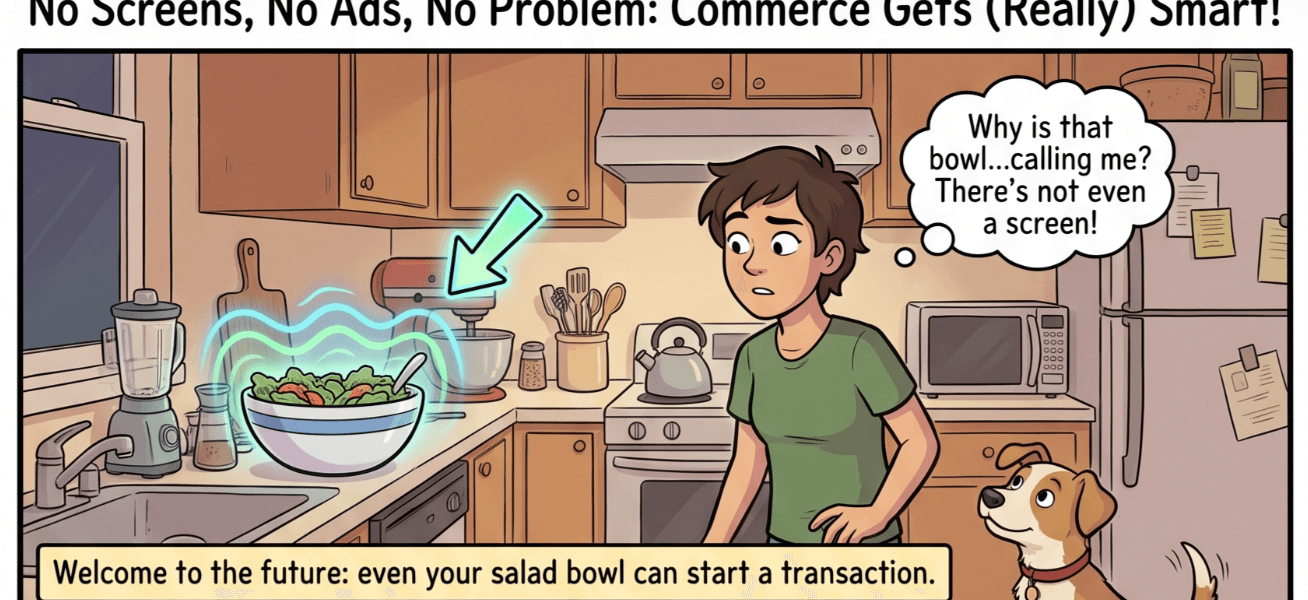
This reverses the entire logic of digital commerce. Instead of a person opening an app, searching, comparing, and checking out, objects broadcast availability and negotiate fulfilment when the user enters their cognitive field.
- A bowl in a friend’s kitchen.
- A lamp in a hotel lobby.
- A jacket worn by a colleague.
The encounter is the interface.
No GUI. No Website. No Checkout.
One of the most radical claims in the paper is also one of the simplest:
Situational Awareness Commerce eliminates graphical interfaces entirely.
Interaction becomes multi-sensory and contextual voice, gesture, proximity, ambient cues. The environment becomes the interface. This collapses traditional UX/UI into embodied interaction, where meaning emerges from movement through space rather than through screens.
This is not speculative. It is a direct extension of IoT3, Ubiquity and Smart Living research from 2016, where objects were already treated as autonomous cognitive entities.
No Identity. No Advertising. No Metadata.
The paper is uncompromising:
Identity is removed from the commercial interaction layer.
Without identity, there is no profiling, no behavioural tracking, no targeted advertising, no persistent accounts, and no purchase history. Commerce becomes structurally anonymous.
This is not only a privacy breakthrough it is a complete dismantling of the surveillance?based commercial models that dominate today’s digital economy.

Autonomous Objects and Item?Level Contracts
Objects carry their own contracts:
- availability
- price
- sustainability constraints
- delivery obligations
- lifecycle responsibilities
These contracts are not stored centrally. They dissolve after fulfilment. This is the foundation of trustless interaction, later formalised in ICCA.
It means commerce can occur without:
- accounts
- payment screens
- delivery scheduling
- identity verification
The ecosystem handles everything.
Blind Delivery and Dissolvable Endpoints
Delivery is where the model becomes truly transformative.
Blind delivery endpoints are temporary, context-specific locations that exist only for the duration of a single fulfilment.
- No addresses.
- No accounts.
- No persistent metadata.
Once the item arrives, the endpoint dissolves. The routing dissolves. The contract dissolves. The interaction dissolves.
This is the first logistics model designed for a world without identity.
Why This Matters
Situational Awareness Commerce removes the cognitive load of modern digital commerce. No browsing. No comparing. No managing accounts. No navigating interfaces.
It also removes the manipulative structures of the attention economy. No advertising. No persuasion. No behavioural profiling.
Commerce becomes:
- ambient
- contextual
- object?driven
- anonymous
- dissolvable
This is not a UX innovation. It is a structural redefinition of how commerce works.
Relationship to ICCA
The paper positions Situational Awareness Commerce as the conceptual precursor to ICCA, providing:
- item?centric accountability
- trustless fulfilment
- provider?blind architecture
- dissolvable interaction models
If ICCA is the protocol layer, Situational Awareness Commerce is the behavioural layer.
The Future: Post?GUI, Post?Identity, Post?Advertising Commerce
Your paper makes a bold claim: the next era of commerce will not be mediated by screens, accounts, or identity. It will be mediated by objects, environments, and cognitive fields.
This is not science fiction. It is a logical continuation of IoT3, Ubiquity, Smart Living, and trustless interaction research.
And it may be the first credible alternative to the surveillance?driven digital economy.
Related papers
- Situational Awareness Commerce: A Post-GUI Model for Object-Driven, Identity-Free Transactions on SSRN
- Situational Awareness Commerce: A Post-GUI Model for Object-Driven, Identity-Free Transactions on Academia
- Identity Constructed Communication Architecture (ICCA) – A Trustless, Model for Provider Blind Communication on SSRN
- Identity Constructed Communication Architecture (ICCA) – A Trustless, Model for Provider Blind Communication on Academia

