AI Governance Is Failing Because It Eliminates Opportunity: Why deterministic controls cannot deliver outcome-optimising decision-making
Why deterministic controls cannot deliver outcome-optimising decision-making
Across industries, AI governance has become a priority. Boards are demanding clarity, regulators are tightening expectations, and organisations are racing to demonstrate responsible AI practices. Yet beneath the surface, a structural flaw is quietly undermining the entire governance effort.
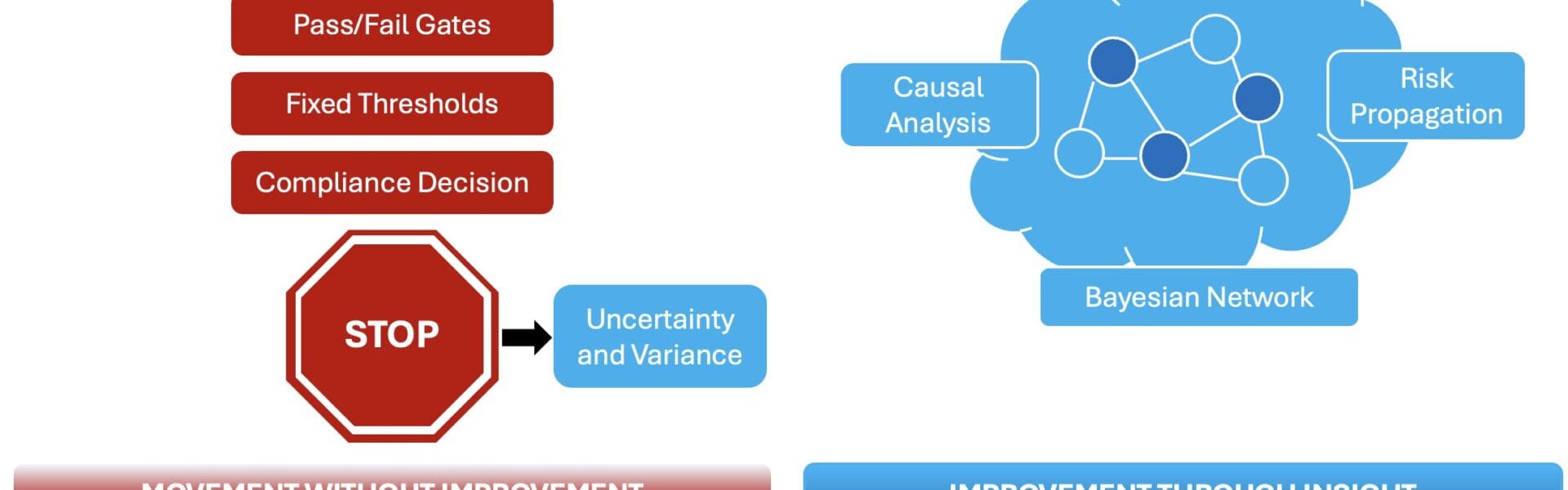
Most organisations are governing AI through deterministic controls: fixed rules, binary thresholds, compliance gates, and rigid approval workflows. These mechanisms create the appearance of safety and accountability, but they do not create better decisions. They create movement not improvement.
At the centre of this problem is a simple but powerful question:
How does deterministic AI governance eliminate organisational opportunity by treating variance as non-compliance, and why do Bayesian Networks provide a superior decision architecture by modelling uncertainty, causal dependencies, and expected outcomes rather than merely enforcing rule-based movement?
This question exposes the gap between what governance currently does and what organisations actually need.
Deterministic governance treats uncertainty as failure
Deterministic controls can only answer three questions:
- Is this allowed
- Does this meet the rule
- Is this compliant
Anything that cannot be guaranteed becomes a risk item.
- Variance is interpreted as instability.
- Instability is interpreted as non-compliance.
- Non-compliance triggers a stop condition.
This is why innovative AI use cases rarely survive enterprise governance. The system is designed to eliminate uncertainty, not understand it. And when uncertainty is eliminated, opportunity is eliminated with it.
This is governance as bureaucracy, not governance as intelligence.
Movement without improvement
Organisations make thousands of decisions every day. The purpose of those decisions is to create better outcomes not merely to execute rules.
Yet deterministic governance reduces decision-making to rule satisfaction.
It produces motion without progress.
- A model passes a checklist.
- A workflow meets a threshold.
- A system satisfies a policy.
But none of these actions guarantee that the organisation is making better decisions, improving future states, or learning from variance. Deterministic governance can only confirm that a rule was followed. It cannot evaluate whether the rule produced a better outcome.
This is the core limitation.
Bayesian Networks treat variance as information
Bayesian Networks offer a fundamentally different decision architecture.
- They do not eliminate uncertainty; they model it.
- They do not fear variance; they use it.
- They do not enforce movement; they optimise outcomes.
They enable organisations to:
- quantify uncertainty
- model causal dependencies
- propagate risk through systems
- simulate alternative futures
- evaluate trade-offs
- learn from new information
- improve decision quality over time
This is governance that aligns with the purpose of decision-making: to create better outcomes, not merely compliant ones.
The strategic cost of deterministic governance
When variance is treated as non-compliance, organisations lose:
- new revenue models
- new operational efficiencies
- new forms of automation
- new customer experiences
- new organisational designs
- new strategic capabilities
This is why most enterprises deploy AI incrementally rather than transformationally. Their governance architecture is structurally biased toward known knowns. Anything emergent, adaptive, or exploratory is filtered out long before it reaches production.
The organisation moves, but it does not improve.
Architectural governance is the way forward
The future of AI governance will not be built on checklists, thresholds, or deterministic controls. It will be built on architectural models that govern uncertainty, not eliminate it. Models that treat identity, causality, and variance as first-class elements of decision-making.
This is where identity-constructed architectures, zero-metadata systems, and Bayesian reasoning converge. They create governance that is structural rather than procedural, adaptive rather than restrictive, and outcome-optimising rather than movement-optimising.
They enable organisations to make decisions that improve future states -not merely satisfy rules.
And lastly
AI governance must evolve from compliance assurance to outcome assurance. Deterministic controls cannot deliver this. Bayesian Networks can. The organisations that recognise this shift will unlock opportunity. Those that do not will continue to move without improving.


