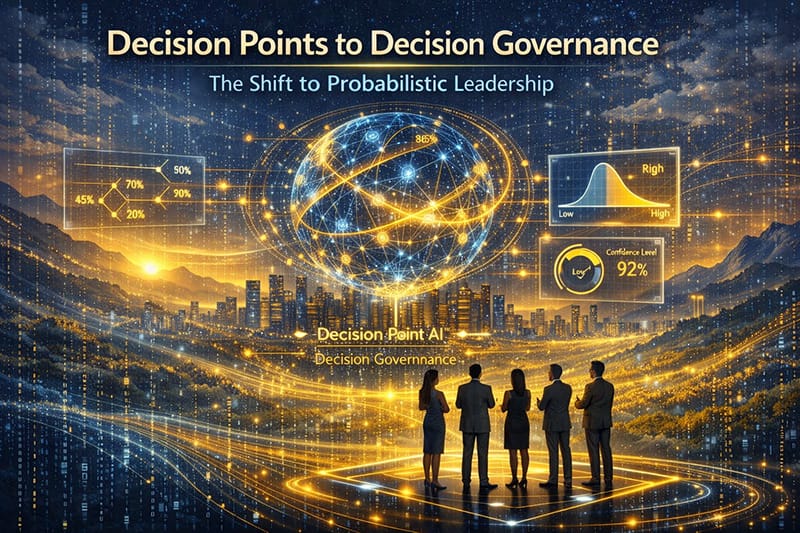
Decision Points to Decision Governance: The Shift to Probabilistic Leadership
The Evolution: Beyond Decision Point AI®
For several years, the concept of Decision Point AI® has served as a vital foundation for modern business. Its goal was clear: identify the exact moment a decision is needed and provide the right person with the right data to make it. It was about cutting through the noise to find the signal.
However, as we move into the AI Organisational Paradigm, we have built upon that foundation. It is no longer enough to just find the “point” of decision; we must now govern the probability of the outcome.
Probabilistic Decision Governance is the massive build that turns decision-making from a series of isolated events into a living, breathing system.

What is Probabilistic Decision Governance?
At its core, this model replaces the “illusion of certainty” with the “calculation of risk.” Instead of a binary “Yes” or “No,” leaders are presented with a spectrum of possibilities. It integrates LLM-enabled decision intelligence to provide:
- Scenario Weighting: Evaluating multiple potential futures simultaneously rather than betting on just one.
- Confidence Scoring: Quantifying how “sure” the system is based on the quality and freshness of the data.
- Risk-Sensitivity Analysis: Ensuring that a decision made in a crisis is governed differently than one made during a period of growth.
Why It Changes Everything
This isn’t just a new piece of software; it’s a fundamental shift in Workforce Capability. Here is why it matters:
- It Exposes Hidden Assumptions Human leaders are prone to overconfidence and “gut feel.” By embedding probabilistic reasoning into everyday pathways, the system acts as a neutral observer, highlighting where assumptions are being made and where evidence is lacking.
- It Creates a “Living” Operating Model This model doesn’t sit in a silo. It integrates directly with Adaptive Portfolio Governance. When probabilities shift, the system doesn’t wait for a quarterly review; it recalibrates priorities and investments in real-time.
- It Ensures Accountability In an AI-augmented world, “The AI told me to do it” is not a valid governance strategy. This framework ensures that every decision-path is mapped, auditable, and aligned with the organisation’s core intent.
What is Decision Point AI®
Decision Point AI® is a specialized intelligence platform and methodology developed by Karl A L Smith. At its core, it is designed to address the “data-decision gap” by identifying the exact moment and the specific intelligence required for a human or system to take effective action.
The system utilizes Bayesian Network intelligence to move beyond simple data analytics. While traditional analytics tell you what happened, Decision Point AI® focuses on:
- Predictive Clarity: Using probabilistic modeling to determine the likely outcomes of different choices.
- Contextual Delivery: Ensuring that intelligence is delivered to the specific person (or AI “colleague”) who has the authority to act at that precise moment.
- Reducing Latency: Eliminating the “wait time” between receiving information and making a decision.
Karl A L Smith’s Ownership
Karl A L Smith is the inventor and trademark owner of Decision Point AI®.
History: He originally created the concept around 2016 (with further commercialisation in 2019) while working as a Product Owner for a high-security Bayesian Network intelligence platform.
Trademark & Legal Status: He holds the registered trademark for Decision Point AI® (UK00003426744), covering classes related to artificial intelligence software, business consultancy, and technological research.
Moving Toward the Paradigm
The transition from the standard Customer Agility Framework™ to this extended AI Organisational Paradigm represents the “last mile” of digital transformation. It moves us away from just being “agile” and toward being AI-native.
By adopting Probabilistic Decision Governance, organisations stop reacting to the world and start navigating it with clarity and confidence. They become capable of acting faster because they finally understand the odds.


