Who are you online?
It sounds like a simple question.
But the answer depends on where the question is being asked.
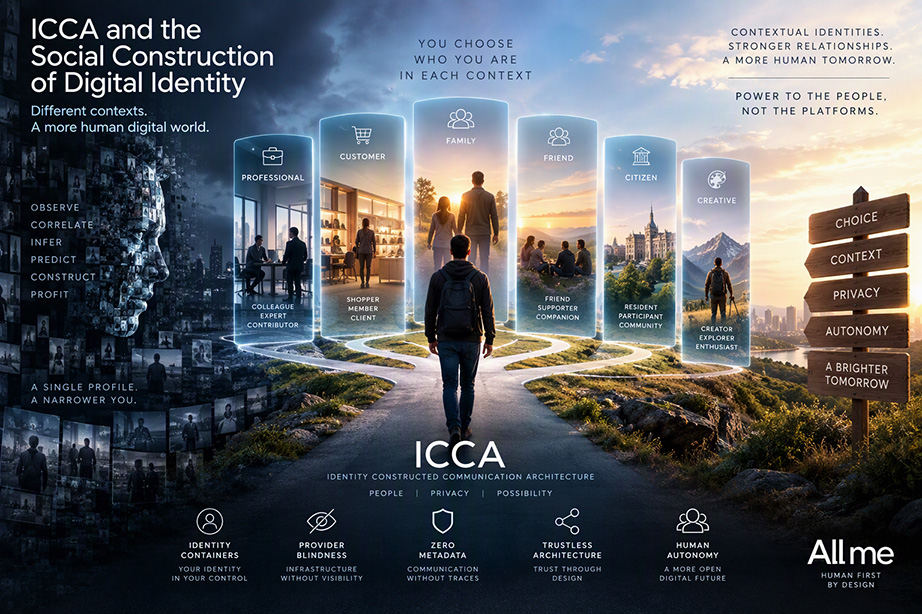
- To your bank, you are a customer.
- To your employer, you are an employee or contractor.
- To a retailer, you are a shopper.
- To your family, you are a relative.
- To friends, you are a friend.
- To a professional community, you may be an expert, colleague or contributor.
- To somebody you have never met, you may simply be a stranger.
All of these identities can be true at the same time.
None necessarily represents the whole person.
Human identity has always worked like this.
It is contextual.
It is relational.
It is partly constructed through our interactions with other people.
But digital technology introduced something different.
It began constructing identities of its own.
When the system starts deciding who you are
Consider what happens when you use a conventional digital service.
The system may observe:
- What you look at.
- What you search for.
- What you buy.
- What you respond to.
- Who you interact with.
- When you interact.
- How frequently you return.
- What appears to interest you.
Individually, these observations may seem insignificant.
Together, they can contribute to a model of the person behind the screen.
The system is no longer simply allowing you to express an identity.
It is potentially constructing an identity about you.
That distinction matters.
There is:
Who you say you are.
And there is:
Who the system concludes you are.
Those are not necessarily the same person.
When identity becomes a prediction
This changes the nature of digital identity.
Traditionally, identity answers a question:
Who is this?
Behavioural systems can introduce a different question:
What is this person likely to do next?
The digital representation can therefore extend beyond information that an individual deliberately provides.
It can become an interpretation.
An inference.
A prediction.
A model.
The person becomes progressively represented not simply by what they have disclosed, but by what technology believes previous behaviour means.
We might think of this as a digital doppelgänger.
Not you.
A computational representation of you.
And increasingly, other digital decisions can be made in response to the doppelgänger rather than the human being.
When different parts of life become one identity
There is another problem.
Human beings naturally maintain different contexts.
What I reveal to a doctor may be different from what I reveal to a retailer.
What colleagues know about me may differ from what my family knows.
What I discuss professionally may have nothing to do with what interests me privately.
This is normal human behaviour.
Digital systems can make those boundaries much weaker.
The same identifiers, devices, accounts and behavioural signals can create continuity between interactions that would otherwise remain separate.
Gradually:
- Shopping can become connected with browsing.
- Browsing can become connected with interests.
- Interests can become connected with relationships.
- Relationships can become connected with location.
- Location can become connected with behaviour.
- Behaviour can become connected with prediction.
Contexts that were naturally separate can begin to collapse into a single digital representation.
The technology knows the connection because the architecture allows the connection to exist.
Does digital identity have to work this way?
This is where ICCA introduces a different proposition.
is built around identity-first communication, zero-knowledge identity containers, blind-provider trust boundaries, cryptographic permissioning and zero-metadata transport. Identity Constructed Communication Architecture (ICCA) – A Trustless, Model for Provider Blind Communication also identifies identity exposure and context collapse among the problems the architecture addresses.
The important idea is not simply that information is better protected.
It is that identity can remain contextual.
Instead of the platform continually constructing an identity around the individual, the interaction can begin with the identity appropriate to that particular context.
That reverses the relationship.
Instead of:
Observe the person. Build a model. Determine the context.
We can begin with:
Establish the context. Present the appropriate identity. Enable the interaction.
The person moves back towards the centre of identity construction.
The right to be different people while remaining the same person
This sounds contradictory, but it reflects normal human life.
You can be:
A professional at 10:00.
A customer at 12:00.
A friend at 18:00.
A family member at 20:00.
You have not changed identity in the conventional sense.
You remain the same human being.
But the identity relevant to each relationship has changed.
The other participants do not automatically need access to the other contexts.
Why should digital technology assume otherwise?
The objective should not necessarily be to create one enormous digital identity capable of representing everything about a person.
Perhaps good digital architecture should enable people to express only the identity appropriate to the relationship taking place.
For a greenfield business
A new digital business has an opportunity to make this decision before identity accumulation becomes embedded in its technology.
It can ask:
What do we actually need to know about this person?
Not:
What could we collect?
Not:
What might become commercially useful later?
Not:
What could help us construct a more detailed customer profile?
But:
What does this specific interaction genuinely require?
That question can produce a very different architecture.
The organisation may not need a universal picture of the customer.
It may only need enough identity to fulfil the purpose of the interaction.
This shifts identity from something accumulated around the customer to something appropriate to the relationship.
For existing organisations
For established organisations, the question is harder.
Digital identity may already be distributed across:
- Customer accounts.
- CRM systems.
- Analytics.
- Marketing technology.
- Personalisation engines.
- Transaction histories.
- Data warehouses.
- Customer profiles.
Each component may seem entirely reasonable.
The broader question is what emerges when they are connected.
Leaders can ask:
Are we maintaining information necessary to serve the customer?
Or:
Are we progressively constructing an organisational model of the customer?
Those are not necessarily the same thing.
And once that distinction becomes visible, another question follows:
Does the organisation actually need the second one?
This is not about anonymity
That distinction is important.
Human autonomy does not require everyone to become anonymous.
There are situations where identity matters.
There are relationships where accountability matters.
There are transactions where particular attributes genuinely need to be established.
The question is whether establishing identity for one legitimate purpose should automatically create an enduring ability to observe the individual across other purposes.
ICCA separates these ideas.
Identity can exist.
Trust can exist.
Accountability can exist.
Relationships can exist.
Without requiring every interaction to contribute to an ever-growing representation of the individual.
What happens when the provider cannot build the doppelgänger?
This is where provider blindness becomes particularly interesting.
If the provider cannot observe sufficient persistent behavioural continuity, the provider has less material from which to continually reconstruct the person.
The technology can still enable the interaction.
But providing the interaction and observing the person become separate capabilities.
That changes the power relationship.
The infrastructure no longer necessarily needs to know enough about the person to construct an alternative identity around them.
This moves ICCA beyond a conventional conversation about privacy.
The question is no longer simply:
Who can see my information?
It becomes:
Who has the power to decide what my information means about me?
Identity should belong in the relationship
Contemporary research increasingly recognises that digital identity develops through online and offline social relationships and that the characteristics of digital platforms themselves influence how identity is enacted. A Social Identity Theory of Digital Identity describes digital identity as shaped by online and offline group memberships while recognising features imposed by the digital platforms on which those identities are enacted.
That makes architecture important.
If identity is socially constructed, digital systems inevitably participate in the environment within which that construction occurs.
But participation does not have to mean ownership.
Technology can enable relationships without becoming the ultimate interpreter of those relationships.
Technology can establish trust without constructing a permanent behavioural identity.
Technology can understand the requirements of an interaction without needing to understand the entire human being.
A question for leaders
Look at the identity your organisation holds about a customer.
Then ask:
How much of this identity did the customer deliberately give us?
And how much did the organisation construct through observation, correlation, inference and interpretation?
Then consider a more difficult question:
If we stopped constructing that additional identity, could we still provide the service the customer actually came to us for?
If the answer is yes, the additional identity may not be necessary for delivering customer value.
If the answer is no, another question becomes necessary:
What exactly has our business model become dependent upon?
That is the adoption question behind ICCA and the Social Construction of Digital Identity.
It does not argue that digital identity should disappear.
It asks something more fundamental.
Should technology help people express who they are, or should technology progressively construct its own version of who those people are?
The underlying ICCA work establishes identity-first communication, identity containers, provider blindness and metadata elimination as architectural elements rather than relying solely on policy to constrain visibility.
Perhaps the future of digital identity is not a more complete digital representation of every human being.
Perhaps it is technology knowing only who we choose to be, in the context where that identity actually matters.
#ICCA #DigitalIdentity #HumanAutonomy #IdentityArchitecture #DigitalTrust #ProviderBlindness #PrivacyByArchitecture #DigitalRights #HumanCentredTechnology #Leadership