Technology does more than enable transactions.
- Over time, it shapes expectations.
- What we consider normal.
- What we believe we must disclose.
- How much observation we tolerate.
- How much control we expect to retain.
And increasingly, how comfortable we have become with digital systems learning from our behaviour.
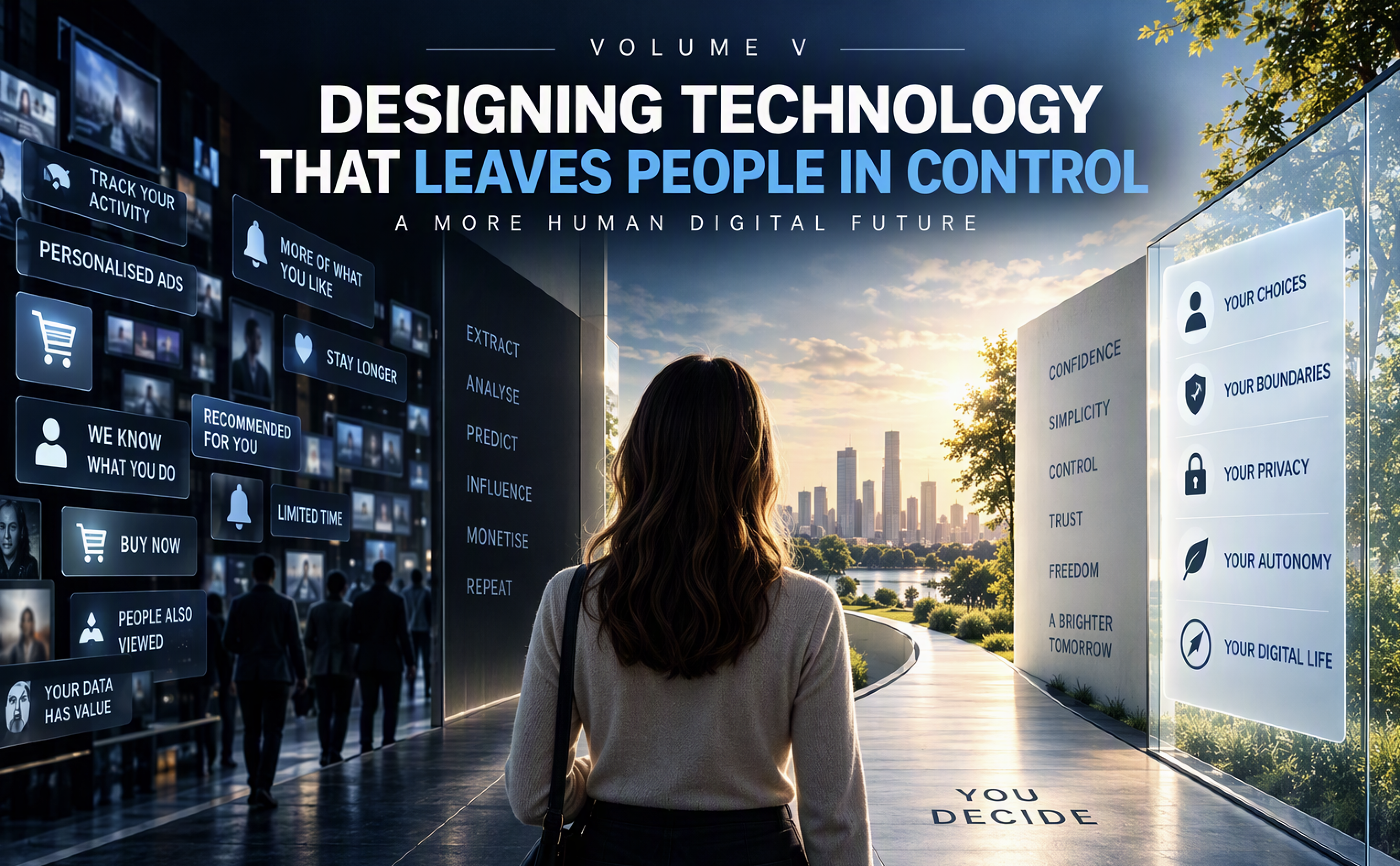
Volume V asks a fundamentally human question:
What should the relationship between people and technology actually feel like?
When familiarity hides complexity
Digital systems deliberately use familiar concepts.
Files. Folders. Documents. Desktops. Shopping baskets. Messages.
These metaphors make complex technology understandable and approachable.
But the experience visible to the person and the activity occurring behind that experience can be very different.
A seemingly simple interaction can create information about identity, activity and behaviour that extends far beyond what the person believes is happening.
This creates an important leadership question:
Do our customers understand the relationship they are actually entering into when they use our digital services?
Data as organisational kryptonite
Volume V introduces a deliberately provocative metaphor:
Data as kryptonite.
The issue is not that data is inherently harmful.
Its risk comes from possession.
Once an organisation possesses information about people, it also acquires responsibility for that information.
- It must protect it.
- Govern it.
- Control access to it.
Determine appropriate uses for it.
And accept the consequences should that responsibility fail.
That changes the executive conversation.
Instead of asking only:
What value could we create from this data?
leaders can also ask:
What responsibility are we accepting by possessing it?
For a greenfield organisation
For a new digital business, this creates an opportunity to consider the human relationship before patterns of collection become embedded.
Rather than beginning with everything technology makes possible, leaders can ask:
What should a person reasonably expect to happen when using this service?
If someone browses, should browsing create a behavioural history?
If someone communicates, must communication create a persistent profile?
If someone purchases something, should that transaction establish an enduring relationship with their identity?
Technology may make these things possible.
That does not automatically make them necessary.
For existing organisations
Established organisations face a different challenge because digital behaviours may already be embedded in technology, processes and commercial models.
Volume V provides another way to examine them.
The question is not simply whether an activity is permitted.
It is:
Does the digital relationship reflect the relationship the customer believes they are having with us?
That difference matters because trust is not created solely through compliance.
It is also created by whether people’s expectations and their lived experience align.
From digital habits to digital autonomy
This is where the broader concept of digital habitus becomes important.
Years of interacting with digital systems establish norms.
We become accustomed to accounts.
- Tracking.
- Permissions.
- Notifications.
- Recommendations.
- Personalisation.
The danger is that familiarity can make architectural choices appear inevitable.
They are not.
Systems can be designed around different assumptions.
Volume V explores what happens when those assumptions place human autonomy, structural privacy and meaningful boundaries at the centre of the experience.
The goal is not technology that makes better decisions for people.
It is technology that enables people to make their own decisions.
A question for leaders
Look at the relationship your organisation has created with its customers and ask:
If customers could see everything our digital systems learn from an ordinary interaction, would the experience still feel reasonable to them?
And then ask the more fundamental question:
What would we design differently if keeping the individual in control were a constraint, rather than simply an aspiration?
That is the adoption question at the heart of Volume V.
The underlying ICCA papers are openly shared under a Creative Commons Attribution-ShareAlike 4.0 licence, allowing the principles to be examined, challenged, adapted and developed beyond All Me.
These articles ask questions that matter to everyday users, business leaders, regulators and policymakers:
- What If the Data You Collect Is Actually Your Liability?
- What Changes When I Don’t Have to Trust You?
- What Changes When People Know They Aren’t Being Watched?
- Who Is Actually Making My Choices Online?
- What If a Successful Digital Experience Ended When I Was Finished?
- Why Does Technology Keep Trying to Bring Me Back?