For much of the digital economy, the customer relationship has expanded far beyond the original transaction.
- Someone buys something.
- But the interaction also creates information.
- What they looked at.
- What they ignored.
- What they bought before.
- How often they return.
- What might interest them next.
Gradually, the behaviour surrounding the transaction becomes valuable in its own right.
This has become so normal that we rarely question the underlying assumption:
Why should understanding customer behaviour be part of the economic value of providing a service?
When the customer creates two forms of value
In a conventional transaction, the organisation creates something a customer values.
The customer pays for it.
Simple.
Digital systems have introduced another possibility.
The interaction itself can generate an additional asset: information about the customer.
That information can potentially support personalisation, segmentation, advertising, prediction and optimisation.
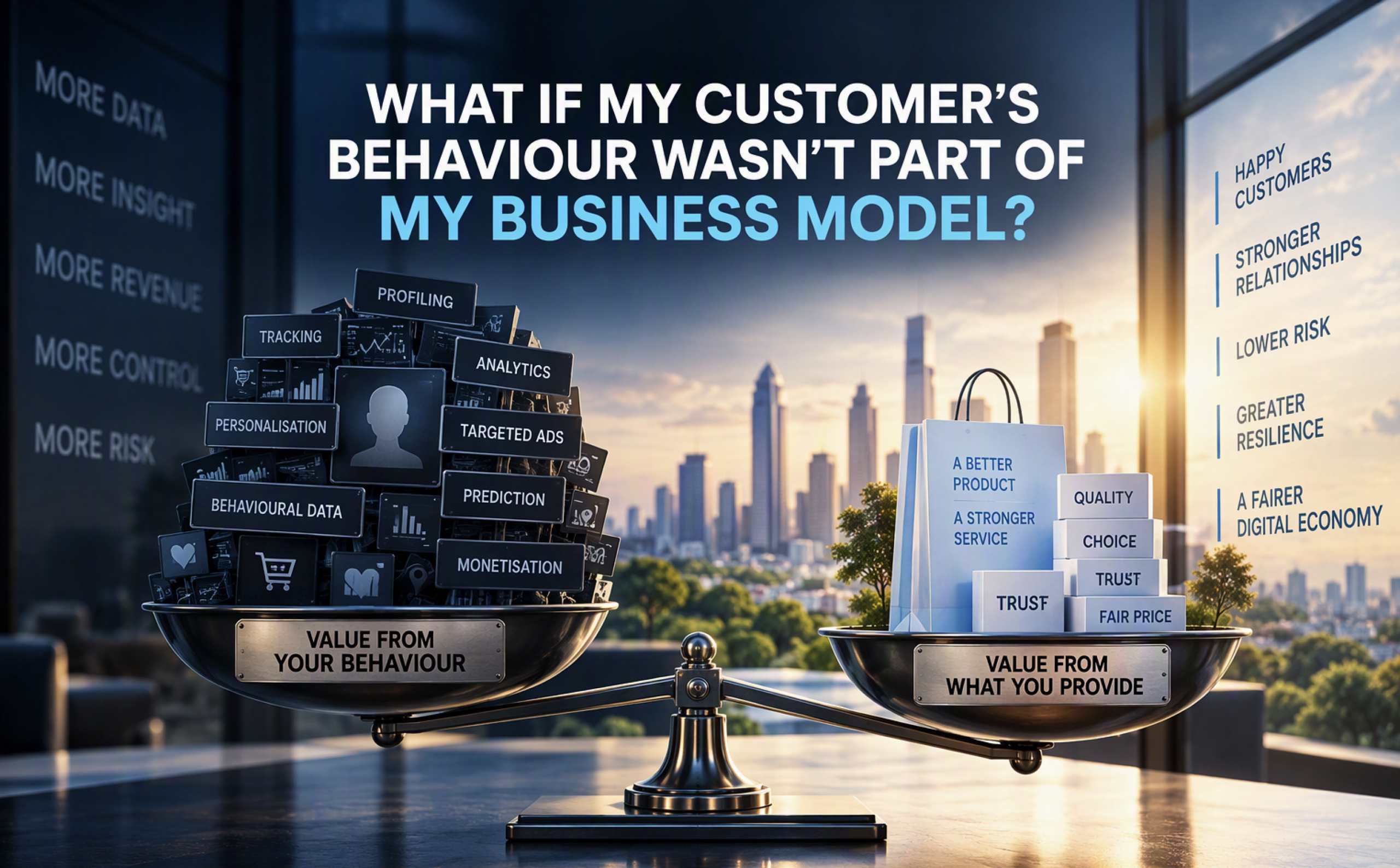
So one customer relationship can effectively produce two things:
Value from the transaction.
Value from understanding the person behind the transaction.
ICCA asks what happens when the second no longer exists.
What if the product had to create the value?
Imagine a digital business that cannot derive commercial value from observing individual behaviour.
It cannot progressively build a behavioural model around the customer.
It cannot depend upon that model to determine what the customer sees next.
It cannot turn accumulated observation into another commercial asset.
The business still needs revenue.
It still needs customers.
It still needs attractive products and services.
But the economics become much more direct:
The business has to create something people consider valuable enough to choose.
That sounds obvious.
Yet it represents a meaningful change from business models where information generated around the customer can become valuable independently of the original service.
For a greenfield business
This creates an interesting strategic opportunity.
Leaders designing a new service can ask:
What would our business model look like if the customer relationship itself generated no secondary behavioural asset?
That question influences far more than privacy.
It affects product strategy.
- Pricing.
- Customer experience.
- Revenue models.
- Marketing.
- Measurement.
- Investment priorities.
And ultimately, what the business considers valuable.
Instead of building the organisation around progressively understanding the customer, the emphasis moves towards progressively improving what the customer actually receives.
For established organisations
The question is inevitably more complicated.
Behavioural information may already support commercial decisions across the enterprise.
The purpose of examining provider-blind economics is therefore not to pretend that this information has no value.
It is to expose the dependency.
Ask:
How much of our business model depends upon the value we provide customers?
Then ask:
How much depends upon the additional value we can extract from knowing those customers?
The answers may reveal two very different economic models operating inside the same organisation.
Knowing less can change the cost side too
There is another part of the equation.
Information is not simply an asset.
Possessing it creates responsibility.
It may require security, governance, compliance, retention controls and organisational processes around its appropriate use.
That means the economic calculation cannot simply be:
What is this information worth?
It also needs to include:
What does possessing this information require of us?
Once both sides enter the equation, knowing more is not automatically synonymous with creating more value.
From human-centred extraction to exchange
This is where provider-blind economics becomes strategically interesting.
The individual does not need to become an economic object surrounding the transaction.
Value can instead centre on what is actually being exchanged:
- The product.
- The service.
- The entitlement.
- The obligation.
- The payment.
- The fulfilment.
The economic relationship becomes about the exchange rather than the exploitable characteristics of the person participating in it.
A question for leaders
Look at your customer proposition and ask:
If we could no longer create commercial value from observing individual customer behaviour, would our business model still work?
If the answer is yes, perhaps behavioural visibility is less important than assumed.
If the answer is no, a second question becomes necessary:
Are our customers paying for our services, or are their behaviours helping to subsidise them?
That is the adoption question behind ICCA: Business Model and Provider-Blind Economics.
It is not merely asking whether organisations can operate while knowing less about customers.
It asks something much more strategically significant:
Can knowing less become the foundation of a viable and differentiated business model?
The underlying ICCA work is openly shared under a Creative Commons Attribution-ShareAlike 4.0 licence, encouraging discussion, challenge, adaptation and further development.
The paper describes the economic model. This article asks what adopting that model could mean for business strategy, customer value and the economics of digital services.
#ICCA #BusinessModel #BusinessStrategy #DigitalEconomy #DigitalTrust #Leadership #CustomerValue #PrivacyByDesign #DigitalTransformation #CreativeCommons